Heather Carson

Projects Installations News Publications Resume Awards Contact


New pieces in the light/ALBERS series

Summer Installation

ACE GALLERY LOS ANGELES
5514 Wilshire Blvd.
Los Angeles, CA 90036
Tu-Sat 10-6
Exhibition extended through September 25, 2010


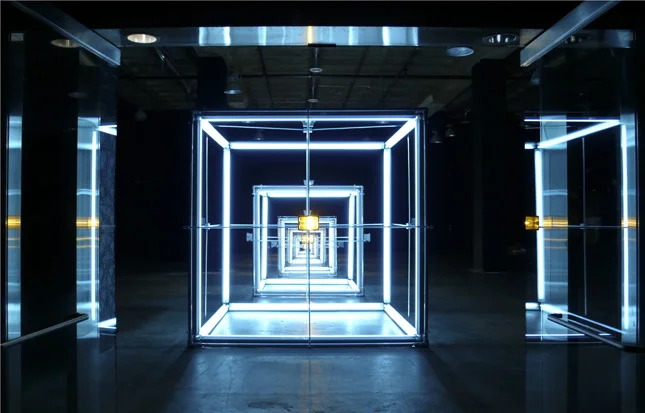
The light/ALBERS exhibition in 2009 consisted of 5 pieces and established the DNA of the series – each of the 4 formats employed in Albers’ Homage to the Square and the range of cool to warm white fluorescent light. It was anchored in the middle by the 3 formats that contain the center square – here depicted using Metal Halide - and used only Cool White fluorescent light in order to articulate the structure. Cool White is not only the center of the Kelvin color temperature scale, but also the most commonly used fluorescent tube, so the use here had several ‘centers’.

The pieces on either end framing the series utilized the remaining format, which removed the central square, whose absence creates a distinct square shadow. The inner square of fluorescents on both was Cool White and then each outlying square was the next sequential color in either the cool spectrum or warm spectrum - to Daylight White on the far left and to Warm White on the far right. The titles list the manufacturers’ colors of fluorescent light foregrounding Albers’ marking of the color of paint and its brand on the back of his paintings.

Albers painted the inside square first and then painted ‘margins’ of color for the outlying squares, each square of color engaging directly with the Liquitex gesso underneath, maintaining the purity of the adjacent colors applied directly from the tube. light/ALBERS begins with either a square of light or shadow in the center and is then surrounded by each ‘margin’ of concentric fluorescents.

The next 4 pieces in this series currently on view consist of one of each of the 4 formats, each one using several whites to more directly explore the impact of adjacency. light/ALBERS uses color theory in light - as well as shadow - to mine the architectural underpinnings of Albers’ investigations into color theory in pigment as the “carrier of the pictorial action”.